Fitness tests / Grip strength
Grip strength
Grip strength is quick to measure and says a surprising amount about overall muscle strength. In large studies, weaker grip is linked with higher risk of disability, hospitalisation and earlier death.
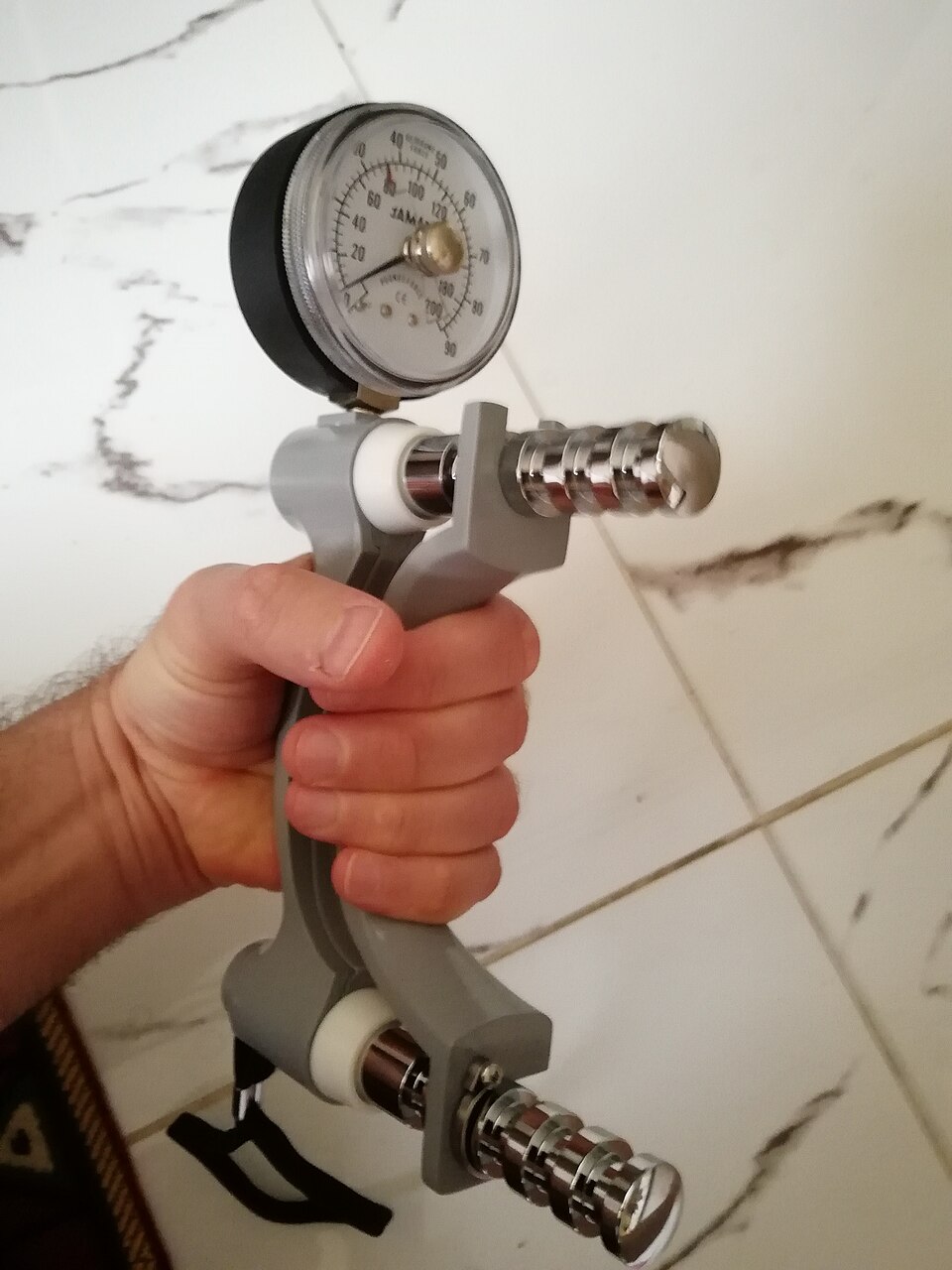
A hydraulic hand dynamometer measures grip force. This photo shows the equipment only; follow the seated test instructions below for arm and body position.
- 2 minutes
- Hand dynamometer
- Both hands, 2–3 tries each
Safety first. Skip this test, or check with a clinician first, if you have a recent hand, wrist or elbow injury or surgery, or a painful flare of arthritis in the hand.
How to do the test
- Sit in a chair with your back supported and feet flat on the floor.
- Keep your upper arm against your side, elbow bent at a right angle, wrist straight.
- Set the dynamometer handle so the middle of your fingers wraps around it comfortably.
- Squeeze as hard as you can for about three seconds, then relax.
- Do two or three tries with each hand, resting about a minute between tries.
- Record the highest reading for each hand.
Why grip strength matters
Grip reflects more than the hand. It tracks closely with strength throughout the body, and it is one of the key measures in international definitions of sarcopenia, the age-related loss of muscle strength and mass. Grip relative to body size is especially informative when body weight is higher, because strength needs to keep pace with the load it carries.
How to read your result
Your strongest reading is compared with the 2025 iGRIPS international reference standards for your age and sex. These norms pool data from about 2.4 million adults in 69 countries and regions. If you enter height, the calculator also shows grip divided by height squared (kg/m²), which reduces the body-size advantage of absolute grip. The EWGSOP2 absolute-grip threshold is shown separately as a clinical case-finding threshold, not a diagnosis. Readings vary between devices, so use the same dynamometer and position each time.
Reference values
Absolute grip-strength reference values by 5-year age band and sex from iGRIPS. The calculator also uses the published height²-normalized reference tables when you provide height.
| Age | 10th | 20th | 50th | 80th | 90th |
|---|---|---|---|---|---|
| 20–24 | 21.7 | 24 | 28.6 | 33.6 | 36.6 |
| 25–29 | 22 | 24.5 | 29.4 | 34.6 | 37.4 |
| 30–34 | 21.8 | 24.4 | 29.7 | 35.2 | 38 |
| 35–39 | 21.3 | 24.1 | 29.7 | 35.4 | 38.4 |
| 40–44 | 20.7 | 23.7 | 29.4 | 35.2 | 38.3 |
| 45–49 | 20.1 | 23.1 | 28.9 | 34.8 | 37.9 |
| 50–54 | 19.4 | 22.4 | 28.2 | 34 | 37.1 |
| 55–59 | 18.5 | 21.5 | 27.3 | 33 | 36.1 |
| 60–64 | 17.6 | 20.6 | 26.2 | 31.8 | 34.9 |
| 65–69 | 16.6 | 19.5 | 25 | 30.5 | 33.4 |
| 70–74 | 15.5 | 18.3 | 23.6 | 28.9 | 31.8 |
| 75–79 | 14.3 | 17 | 22.1 | 27.2 | 29.9 |
| 80–84 | 12.9 | 15.5 | 20.4 | 25.3 | 28 |
| 85–89 | 11.4 | 13.9 | 18.6 | 23.3 | 25.9 |
| 90–94 | 9.8 | 12.2 | 16.7 | 21.2 | 23.6 |
| 95–99 | 8 | 10.3 | 14.6 | 18.9 | 21.2 |
| 100+ | 6.1 | 8.3 | 12.4 | 16.5 | 18.7 |
International iGRIPS norms (Tomkinson et al., 2025; 2.4 million adults, 69 countries/regions), harmonized to a seated hydraulic-dynamometer protocol with both hands, 3 trials per hand, and the maximum value.
Enter your result
References
- Tomkinson GR, Lang JJ, Rubín L, et al; iGRIPS Group. International norms for adult handgrip strength: a systematic review of data on 2.4 million adults aged 20 to 100+ years from 69 countries and regions. J Sport Health Sci. 2025;14:101014. Source record
- Leong DP, et al. Prognostic value of grip strength: findings from the Prospective Urban Rural Epidemiology (PURE) study. Lancet. 2015;386(9990):266–273.
- Cruz-Jentoft AJ, et al. Sarcopenia: revised European consensus on definition and diagnosis (EWGSOP2). Age Ageing. 2019;48(1):16–31.
- Roberts HC, et al. A review of the measurement of grip strength in clinical and epidemiological studies. Age Ageing. 2011;40(4):423–429.
Grip photograph credit
Equipment photograph by Ashashyou, via Wikimedia Commons. CC0 public-domain dedication. Display resized; no device or hand features have been generated or altered. This close-up illustrates the equipment, not the full testing posture.