At a typical checkup, someone measures your blood pressure, pulse and weight. Two measurements that say a great deal about your future health are usually missing: how fit your heart and lungs are, and how strong your muscles are.
I recently reviewed the research on these two measurements with colleagues. This is the plain-language version of what we found.
Two numbers, two different stories
Link to this section: Two numbers, two different stories
Fitness is how well your heart, lungs, blood vessels and muscles work together to use oxygen when you exert yourself. Scientists often describe it in units called METs. One MET is the energy your body uses sitting still, so someone who can work at 10 METs can briefly go about ten times harder than resting.
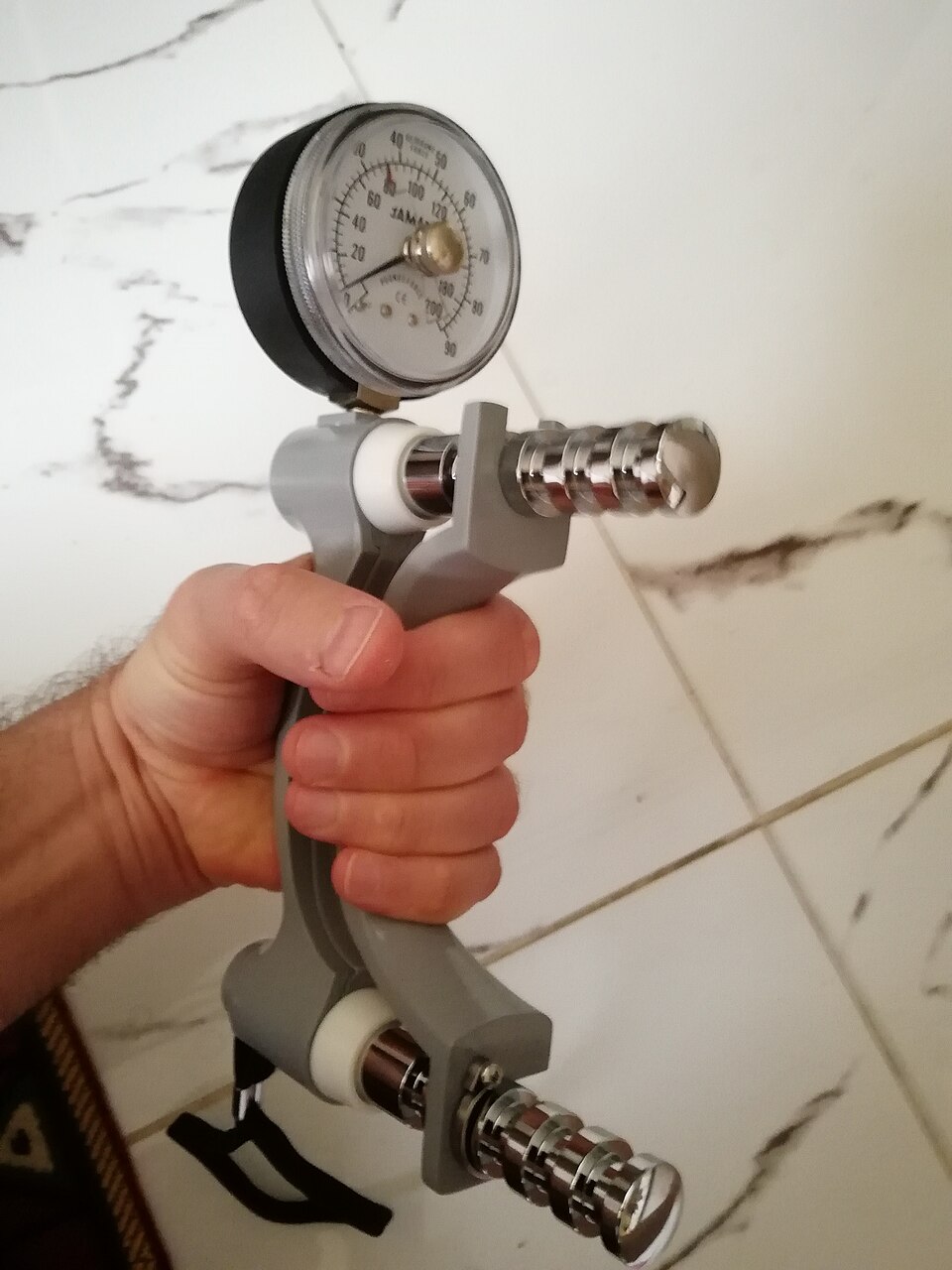
Strength is easiest to check with a grip test. Squeezing a hand dynamometer takes about two minutes, and grip strength tracks closely with strength in the rest of the body.
Both peak in early adulthood and decline with age, faster after midlife. Both can be improved at any age.
What the research shows about fitness
Link to this section: What the research shows about fitness
When researchers combined 33 studies of about 100,000 people, each one-MET rise in fitness was linked to about 13% lower risk of dying during the studies and 15% fewer heart problems.
In 122,000 adults who had treadmill tests, the least fit had about five times the risk of dying of the fittest. A more everyday comparison is below-average versus above-average fitness: that gap carried about the same extra risk as smoking or diabetes. There was no point at which being fitter seemed to become harmful.
The pattern holds at every age. In 750,000 US veterans, fitter people lived longer in every age group, including people in their 70s and 80s. Fitness in midlife is also linked to brain health: in one large study, the fittest group had about a third less dementia later in life than the least fit.
Low fitness is about as risky as smoking or diabetes
Extra risk of dying over about 8 years
Below-average fitnesscompared with above-average fitness
+41%
Smokingcompared with never smoking
+41%
Diabetescompared with no diabetes
+40%
Heart diseasenarrowed heart arteries, compared with none
+29%
Least fit vs fittestThe widest gap in the study
About 5 times the risk of dying during the study.
What the research shows about strength
Link to this section: What the research shows about strength
Across studies of nearly 2 million adults, people in the stronger groups had about 31% lower risk of dying during follow-up.
In two very large studies, one of half a million people in the UK and one of 140,000 people in 17 countries, every 5 kg (11 lb) of weaker grip was linked to about 16% to 20% higher risk of dying. Weaker grip is also linked to heart failure, type 2 diabetes, dementia, falls and losing independence.
Why it helps to know both
Link to this section: Why it helps to know both
Fitness and strength are related but not the same. A strong person can be unfit, and a fit person can be weak. In a study that measured both in over 70,000 adults, each one predicted risk on its own, and people who scored high on both had about half the risk of dying.
Fitness appears to be the stronger signal of the two. That matters: a good grip does not mean you can skip checking your fitness. The Fitness Meter puts both side by side for this reason.
The good news: both can improve
Link to this section: The good news: both can improve
In controlled trials, regular endurance exercise raised fitness by about 1.4 METs. Those trials mostly involved younger adults; older adults usually gain less, but they still gain.
Strength responds too. In a trial in older adults, a three-month home program of strength exercises plus extra protein improved grip strength and cut the chance of becoming frail. For roughly every eight people who did the program, one avoided frailty.
The honest part: a number alone is not enough
Link to this section: The honest part: a number alone is not enough
Two trials tested what happens when people are simply given their fitness and strength numbers with some advice. On their own, the numbers did not change how active people were overall. Measuring helps when it leads to a plan.
It is also worth knowing the limits of this research. Most of it shows links, not proof: illness can lower both fitness and strength, so some of the risk may come from underlying disease. And most reference values come from US and UK populations that were predominantly white.
How to put this to work
Link to this section: How to put this to work
- Measure your grip with both hands.
- Estimate your fitness with the one-mile walk test.
- If a result is low, act on it: strength training at least two days a week for low grip, and more brisk walking, built up gradually, for low fitness.
- Recheck every 6 to 12 months, the same way each time.
- Know what counts as a real change. A grip change of less than about 5 kg or 10%, or a walking-test change of less than 10% to 15%, may just be normal variation from test to test. The site tells you which it is when you save a repeat result.
Talk with your clinician if your grip is below 27 kg (men) or 16 kg (women), if you see a real drop between tests, if your fitness is below the 25th percentile for your age, or if you have any symptoms during exercise.
Try it yourself. Check your fitness and strength together and save it to follow your trend.
This article is for general education and is not medical advice for any individual.
References
- Kodama S, et al. Cardiorespiratory fitness as a quantitative predictor of all-cause mortality and cardiovascular events in healthy men and women: a meta-analysis. JAMA. 2009;301(19):2024–2035. Source record
- Mandsager K, et al. Association of cardiorespiratory fitness with long-term mortality among adults undergoing exercise treadmill testing. JAMA Netw Open. 2018;1(6):e183605. Source record
- Kokkinos P, et al. Cardiorespiratory fitness and mortality risk across the spectra of age, race, and sex. J Am Coll Cardiol. 2022;80(6):598–609.
- DeFina LF, et al. The association between midlife cardiorespiratory fitness levels and later-life dementia. Ann Intern Med. 2013;158(3):162–168.
- García-Hermoso A, et al. Muscular strength as a predictor of all-cause mortality in an apparently healthy population: a systematic review and meta-analysis. Arch Phys Med Rehabil. 2018;99(10):2100–2113.
- Celis-Morales CA, et al. Associations of grip strength with cardiovascular, respiratory, and cancer outcomes and all cause mortality. BMJ. 2018;361:k1651.
- Leong DP, et al. Prognostic value of grip strength: findings from the PURE study. Lancet. 2015;386(9990):266–273.
- Kim Y, et al. The combination of cardiorespiratory fitness and muscle strength, and mortality risk. Eur J Epidemiol. 2018;33(10):953–964.
- Milanović Z, et al. Effectiveness of high-intensity interval training and continuous endurance training for VO₂max improvements. Sports Med. 2015;45(10):1469–1481.
- Travers J, et al. Building resilience and reversing frailty: a randomised controlled trial of a primary care intervention for older adults. Age Ageing. 2023;52(2):afad012.
- Bornhöft L, et al. Monitoring handgrip strength to motivate lifestyle choices for patients with diabetes type 2: a pragmatic randomised controlled trial. Scand J Prim Health Care. 2024;42(4):617–632.
- Langland JT, et al. Do assessments of cardiorespiratory and muscular fitness influence subsequent reported physical activity? A randomized controlled trial. BMC Sports Sci Med Rehabil. 2021;13(1):69.
- Bohannon RW. Minimal clinically important difference for grip strength: a systematic review. J Phys Ther Sci. 2019;31(1):75–78.
- Ross R, et al. Importance of assessing cardiorespiratory fitness in clinical practice: a case for fitness as a clinical vital sign. Circulation. 2016;134(24):e653–e699.
Cite or share this article
Bernard Aoun, MD. Fitness and strength: the two vital signs most checkups miss. Tortoise Time. Updated September 2026. https://www.tortoisetime.com/learn/fitness-and-strength-vital-signs
Permanent article link · About the author
Keep the testing method, population and limitations with any quoted finding. A page update is not evidence of an independent medical review.