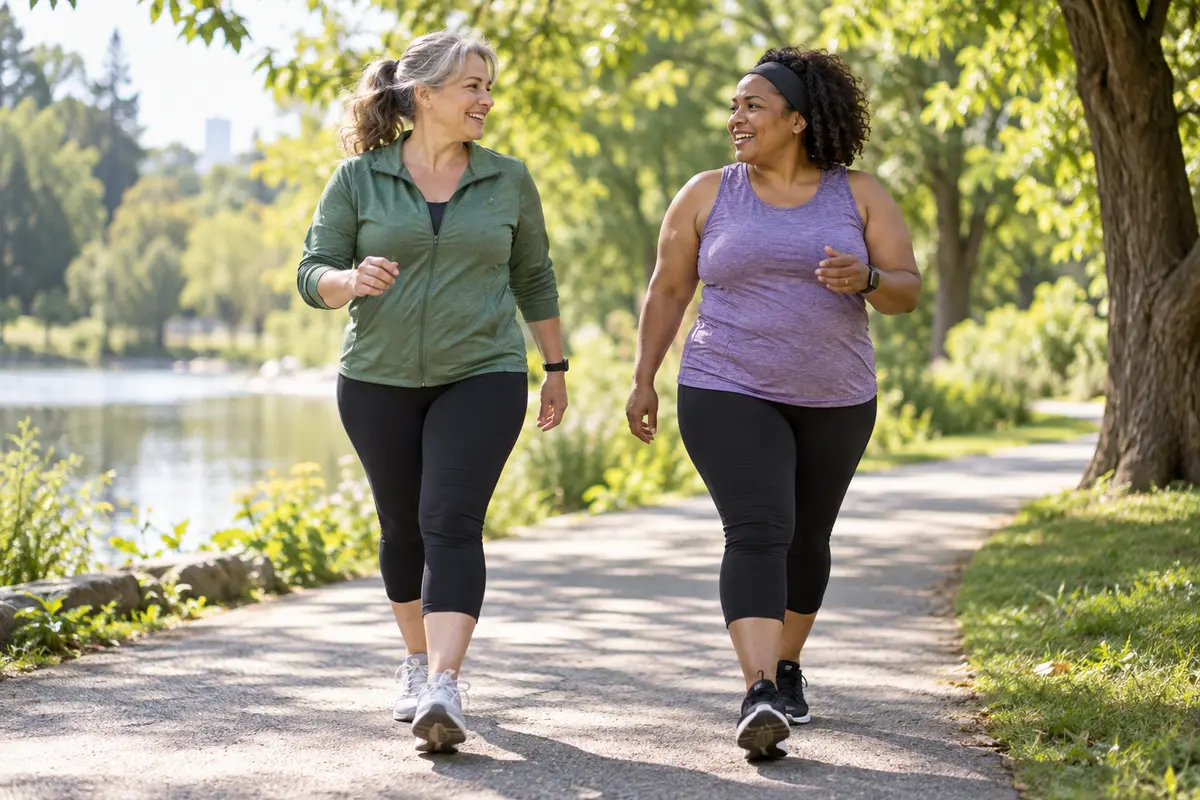
Most health advice starts with the bathroom scale. But researchers have long suspected that how fit you are may matter more than what you weigh. A large 2024 review put that idea to the test.
- ~400,000
people in 20 studies, with fitness measured on a treadmill or bike, not by questionnaire.
- 2–3×
higher risk of dying for unfit people in every weight group.
- No extra
risk for fit people who were overweight or had obesity, compared with fit people of normal weight.
What the researchers did
Link to this section: What the researchers did
Researchers pooled 20 studies that measured both fitness, with a proper exercise test, and body mass index (BMI). They grouped people as fit or unfit, and as normal weight, overweight or with obesity, then compared everyone with people who were fit and of normal weight.
Risk of dying from any cause, by fitness and weight
Compared with people who were fit and normal weight (1.0 = the same risk)
Fit, normal weightthe comparison group
×1.00
Fit, overweightnot meaningfully different
×0.96
Fit, with obesitynot meaningfully different
×1.11
Unfit, normal weight
×1.92
Unfit, overweight
×1.82
Unfit, with obesity
×2.04
The pattern is striking. Being unfit roughly doubled the risk of dying during the studies, whatever people weighed. Being fit seemed to cancel out most of the extra risk usually linked with carrying more weight.
What this does and doesn’t mean
Link to this section: What this does and doesn’t mean
It doesn’t mean weight never matters. Excess weight is still linked with type 2 diabetes, joint pain, sleep apnea and other problems. But it does mean the scale can hide what’s going on underneath. A person who weighs more but walks briskly every day may be in better shape than a thinner person who rarely moves.
It also means you don’t need to wait for weight loss to get the benefit. The authors noted that the biggest drop in risk comes when someone who is inactive becomes even moderately active.
Where to start
Link to this section: Where to start
- Find out where you stand with the one-mile walk test.
- Build toward about 150 minutes a week of brisk walking or similar activity, in any size chunks.
- Add some harder efforts, such as hills or faster stretches, once or twice a week as you get fitter.
- Re-test every few months and watch the trend, not the scale.
Try it yourself. Estimate your fitness with the one-mile walk test
This article is for general education and is not medical advice for any individual.
References
- Weeldreyer NR, et al. Cardiorespiratory fitness, body mass index and mortality: a systematic review and meta-analysis. Br J Sports Med. 2025;59(5):339–346.
- Kodama S, et al. Cardiorespiratory fitness as a quantitative predictor of all-cause mortality and cardiovascular events. JAMA. 2009;301(19):2024–2035. Source record
Cite or share this article
Bernard Aoun, MD. Fit and heavier, or thin and unfit? What matters more for long life. Tortoise Time. Updated September 2026. https://www.tortoisetime.com/learn/fitness-versus-weight
Permanent article link · About the author
Keep the testing method, population and limitations with any quoted finding. A page update is not evidence of an independent medical review.