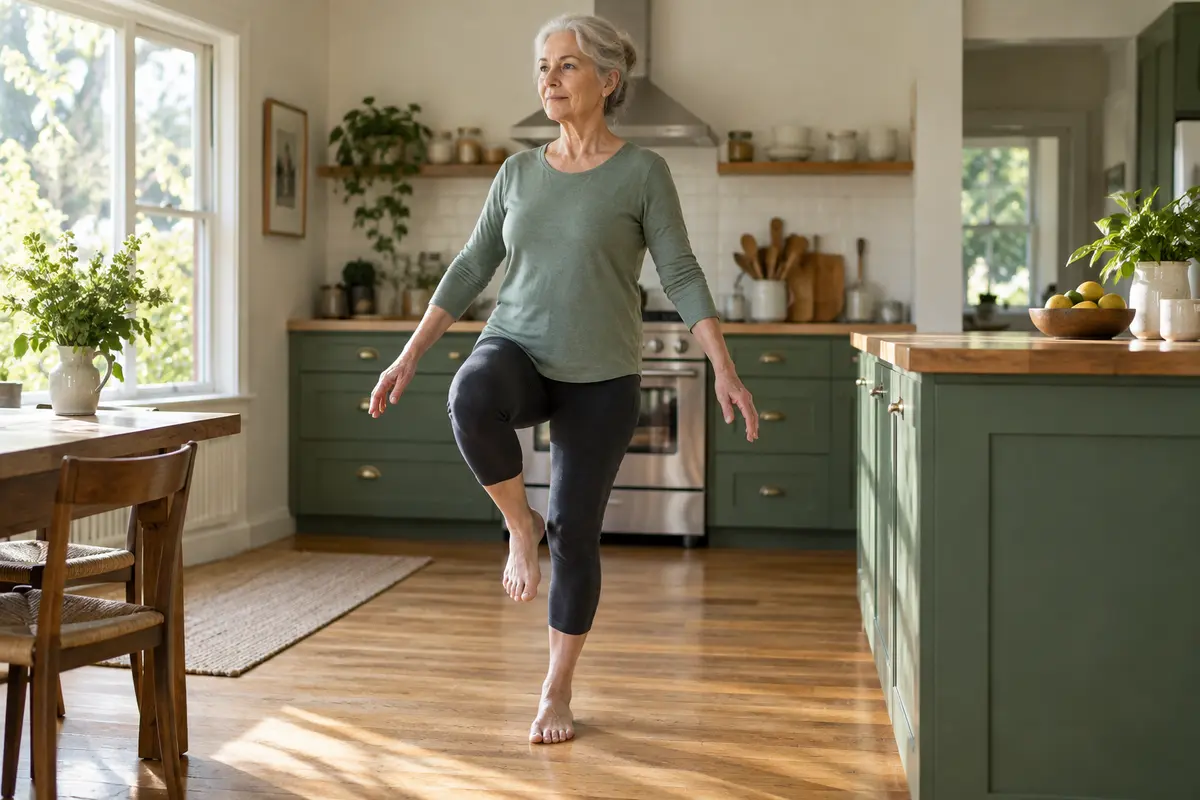
Balance quietly holds up everything we do: getting dressed, stepping off a curb, turning to look behind us. It tends to stay fairly steady until our 50s and then declines faster than strength or fitness. That makes it worth checking, and worth training.
- 1 in 5
adults aged 51 to 75 couldn’t stand on one leg for 10 seconds.
- 84%
higher risk of dying over about 7 years for those who couldn’t, after accounting for age and health.
- 23%
fewer falls in older adults who did regular exercise, especially balance training.
The study
Link to this section: The study
Researchers in Brazil asked 1,702 adults aged 51 to 75 to stand on one leg for 10 seconds, with the free foot resting against the back of the standing leg, arms by their sides and eyes straight ahead. They got three tries. About one in five couldn’t do it, and the chance of failing climbed steeply with age.
Couldn’t stand on one leg for 10 seconds
Share of people in each age group
Age 51–55
5%
Age 56–60
8%
Age 61–65
18%
Age 66–70
37%
Age 71–75
54%
Over about seven years of follow-up, people who failed the test had 84% higher risk of dying from any cause, even after the researchers accounted for age, sex, weight and conditions such as diabetes and heart disease. That doesn’t mean poor balance itself is deadly. It is more likely a signal of how well the body’s systems are working together.
Why balance matters: falls
Link to this section: Why balance matters: falls
About one in four US adults aged 65 and over falls each year, and worldwide falls cause nearly 700,000 deaths a year. The good news is that balance responds well to practice. A large Cochrane review of 108 trials found that regular exercise reduced the number of falls in older adults by about 23%. Balance and functional exercises, and tai chi, worked especially well.
Try the test safely
Link to this section: Try the test safely
- Stand next to a kitchen counter or sturdy chair you can grab if needed. Have someone nearby if you are unsure.
- Rest the front of one foot against the back of your other lower leg. Keep your arms by your sides and look straight ahead.
- Count to 10. Try up to three times on each leg.
- If you have fallen recently, feel dizzy or are unsteady, skip it and talk with your clinician.
To improve, practice standing on one leg while brushing your teeth or waiting for the kettle, holding the counter at first.
Try it yourself. Check your leg strength and mobility with the chair stand test
This article is for general education and is not medical advice for any individual.
References
- Araujo CG, et al. Successful 10-second one-legged stance performance predicts survival in middle-aged and older individuals. Br J Sports Med. 2022;56(17):975–980.
- Sherrington C, et al. Exercise for preventing falls in older people living in the community. Cochrane Database Syst Rev. 2019;1:CD012424.
- World Health Organization. Falls: fact sheet. 2021.
Cite or share this article
Bernard Aoun, MD. Can you stand on one leg for 10 seconds?. Tortoise Time. Updated September 2026. https://www.tortoisetime.com/learn/ten-second-balance-test
Permanent article link · About the author
Keep the testing method, population and limitations with any quoted finding. A page update is not evidence of an independent medical review.