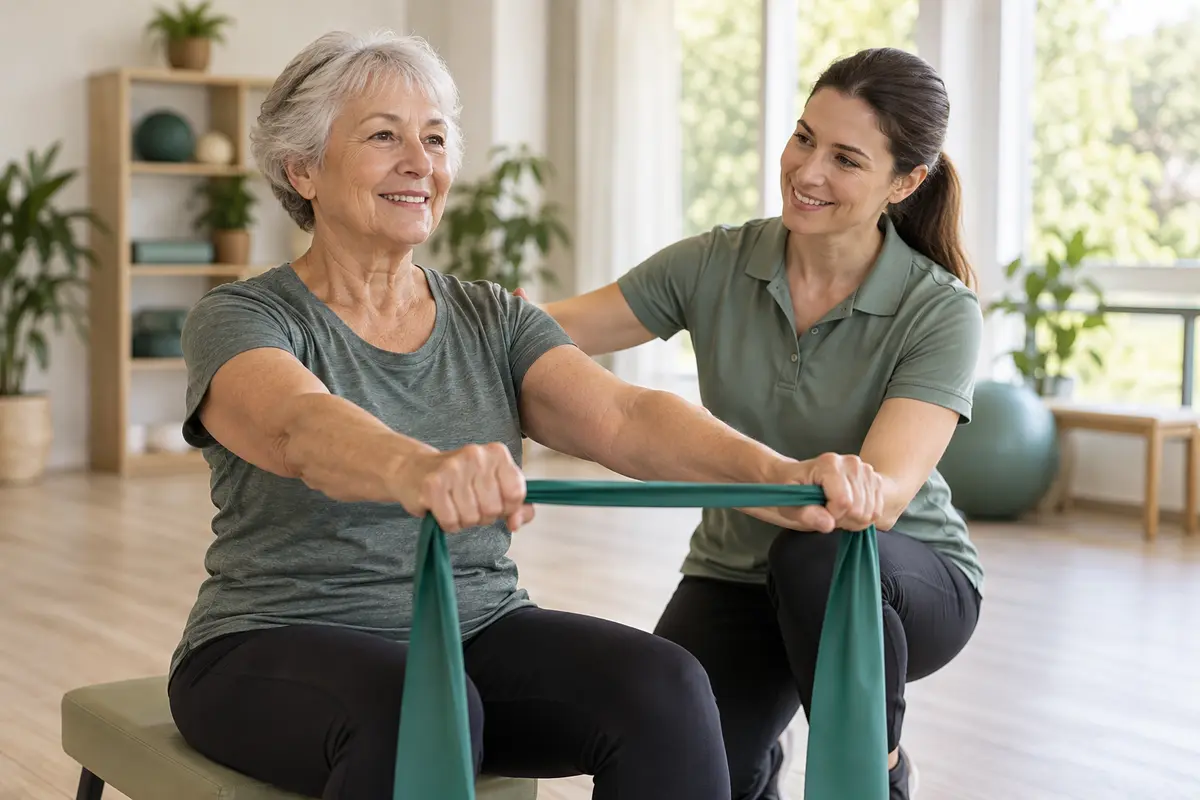
Frailty is what happens when the body’s reserves run low: muscles weaken, walking slows, energy drops, and a minor illness can knock someone off their feet for weeks. It’s common in later life, but it’s not simply “old age.” It can be slowed, and sometimes reversed.
- 1,519
adults aged 70 and over in 11 European countries took part.
- 22%
lower risk of losing the ability to walk 400 metres in the exercise group.
- ~2 years
average follow-up, with strength, walking and balance training.
The trial
Link to this section: The trial
SPRINTT, published in 2022, enrolled older adults who already had weak muscles and slower physical performance but could still walk 400 metres, about a quarter mile. Half were assigned to a program of moderate physical activity twice a week at a centre plus up to four sessions at home, combining walking, strength, flexibility and balance, with activity trackers and nutrition advice. The other half received healthy-aging education.
Lost the ability to walk 400 metres
Among participants with lower physical performance at the start
Healthy-aging educationcomparison group
52.7%
Exercise programstrength, walking, balance
46.8%
The exercise group was 22% less likely to lose the ability to walk that distance, and their physical performance scores were better at two and three years. Women in the program also lost less muscle and less grip strength.
The honest details
Link to this section: The honest details
The benefit was clear in people who started with lower performance. In participants who were already doing a bit better at the start, the program didn’t make a significant difference over the study period. That doesn’t mean exercise is pointless for them; it may mean the benefit takes longer to show, or that they were already fairly active.
What it means for you
Link to this section: What it means for you
- Frailty responds to training. Strength, walking and balance work together.
- Consistency matters more than intensity. The program was moderate, twice a week with a group plus sessions at home.
- Track warning signs: slower walking, weaker grip, trouble rising from a chair. The assessments on this site measure all three.
Try it yourself. Check your grip strength
This article is for general education and is not medical advice for any individual.
References
- Bernabei R, et al. Multicomponent intervention to prevent mobility disability in frail older adults: randomised controlled trial (SPRINTT project). BMJ. 2022;377:e068788.
- Fried LP, et al. Frailty in older adults: evidence for a phenotype. J Gerontol A Biol Sci Med Sci. 2001;56(3):M146–M156.
Cite or share this article
Bernard Aoun, MD. Frailty is not inevitable: what a major European trial found. Tortoise Time. Updated September 2026. https://www.tortoisetime.com/learn/frailty-is-not-inevitable
Permanent article link · About the author
Keep the testing method, population and limitations with any quoted finding. A page update is not evidence of an independent medical review.