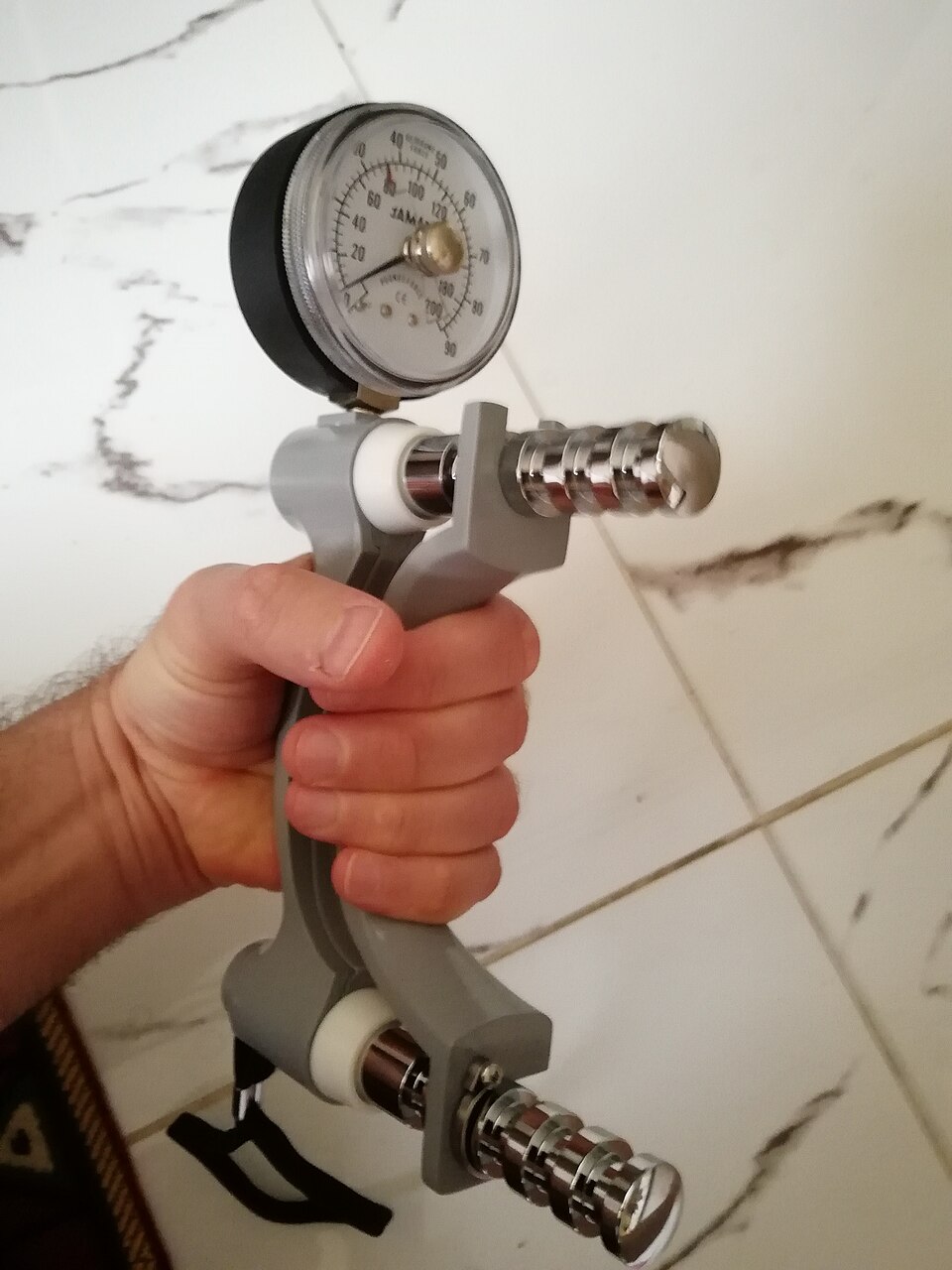
Few clinical measurements are as quick, cheap and informative as grip strength. You hold a small device, squeeze as hard as you can for a few seconds, and read a number. Yet that number tracks closely with strength throughout the body, and with how people fare as they age.
What the research shows
Link to this section: What the research shows
In the Prospective Urban Rural Epidemiology (PURE) study, which followed nearly 140,000 adults across 17 countries, each 5 kg lower grip strength was associated with about a 16% higher risk of death from any cause. Grip predicted cardiovascular death more strongly than systolic blood pressure did.1
These are associations, not proof that squeezing harder makes you live longer. Grip is best understood as a window onto overall muscle health, which in turn reflects activity, nutrition, illness and age.
Thresholds clinicians use
Link to this section: Thresholds clinicians use
The European consensus on sarcopenia uses a grip below 27 kg in men and 16 kg in women to flag low muscle strength.2 The US FNIH project also looked at grip relative to body mass index, because a heavier body needs more strength to move it.3 That relative measure matters for sarcopenic obesity, where low strength is hidden inside a larger frame.
What improves it
Link to this section: What improves it
Hand grippers can raise grip itself, but the goal is whole-body strength. Resistance training for the major muscle groups two or more days a week, enough protein, and staying active every day are what move the underlying picture. Grip then becomes a convenient way to check progress.
Try it yourself. Record your grip strength and save it to follow your trend.
This article is for general education and is not medical advice for any individual.
References
- Leong DP, et al. Prognostic value of grip strength: findings from the PURE study. Lancet. 2015;386(9990):266–273.
- Cruz-Jentoft AJ, et al. Sarcopenia: revised European consensus on definition and diagnosis. Age Ageing. 2019;48(1):16–31.
- Studenski SA, et al. The FNIH Sarcopenia Project. J Gerontol A Biol Sci Med Sci. 2014;69(5):547–558.
Cite or share this article
Bernard Aoun, MD. Grip strength: a two-minute window into how you are ageing. Tortoise Time. Updated September 2026. https://www.tortoisetime.com/learn/grip-strength-window-into-ageing
Permanent article link · About the author
Keep the testing method, population and limitations with any quoted finding. A page update is not evidence of an independent medical review.